
Intro
I am old enough to know that before Google, we had something called man pages and you had to read, consume, and try. Then came ChatGPT.
Scientists have been thinking for a while what effect this has on the human brain. We now know.
MIT have confirmed that yes, perhaps, just maybe, offloading your entire cognitive process to a robot might have side-effects.
Shocking.
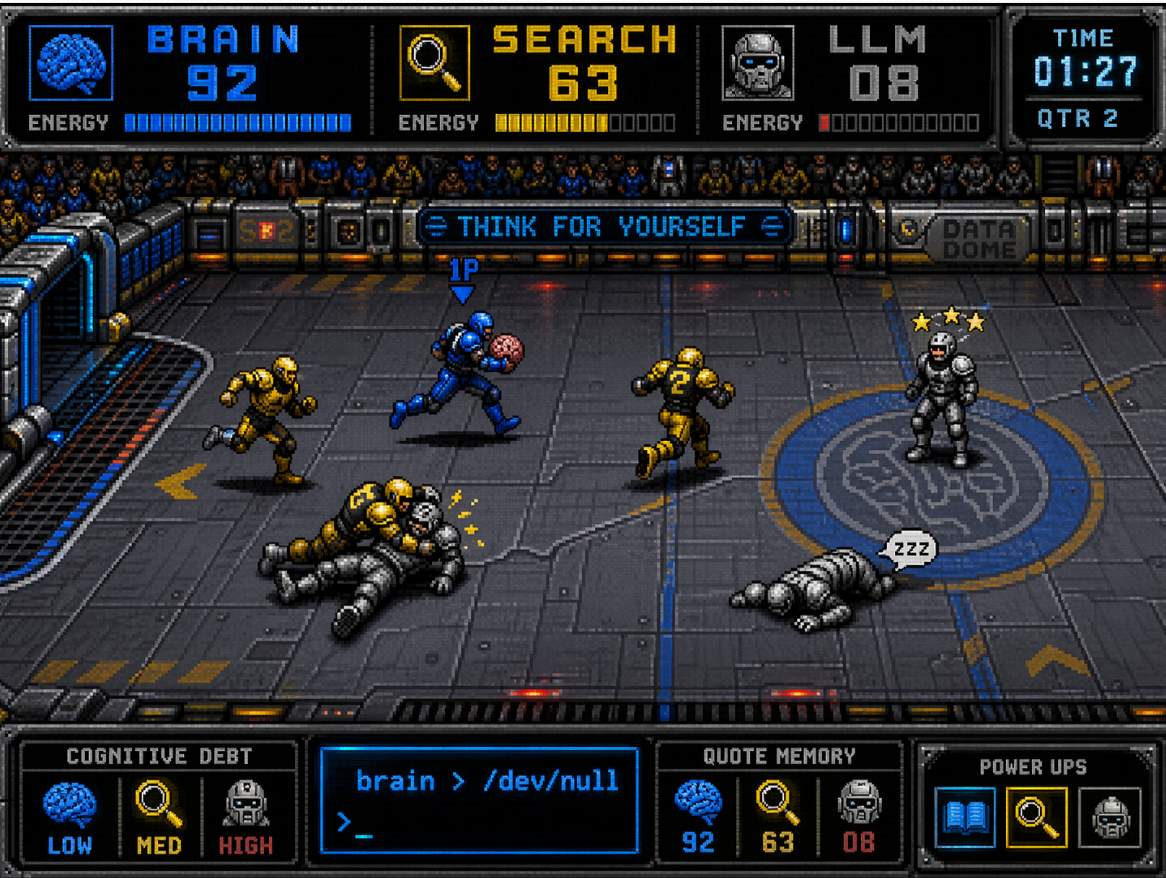
The setup: three groups enter, one group remembers nothing
MIT split participants into three noble tribes:
1. Brain-only 2. Search-engine 3. Let GPT-4 do the heavy lifting
The results? Well.
The Brain-only group lit up the EEG like a Christmas tree. The Search group engaged enough neurons to suggest something was happening behind the eyes. The LLM group? Their brains idled.
brain > /dev/null
Participants using ChatGPT then attempted to quote their own essays. They failed. Magnificently. Across sessions, the LLM group displayed quoting accuracy that would embarrass a malfunctioning Speak & Spell. Meanwhile, the Brain-only group remembered their own words — a live-action remake of the Google-effect story about remembering where rather than what [2].
Cognitive debt: buy now, pay later
Every time you let an LLM construct your ideas, you accrue what we call cognitive debt [1]. In old-fashioned terms, you are shrinking the part of cognitive load that actually builds schemas and understanding, and maximising the part where you let the tool carry you along [3].
Over repeated sessions, the LLM group showed neural connectivity dropping toward the complexity level of a screensaver [1]. But the best bit comes in Session 4, when the AI-dependent participants are suddenly told: now write without GPT.
Their brains have a little bit of a segfault and panic.
Connectivity drops and engagement collapses. The whole system behaves as if someone unplugged their brain. It is a small, slightly tragic demo of what happens when agency is steadily offloaded to a machine that never sleeps and never argues with you [4].
Search group
The Search-engine group, ironically, looked the most like humans. They activated memory, decision-making, prior knowledge, and actual learning [1].
Scrolling past ten SEO-choked blog posts turns out to be more cognitively stimulating than typing rewrite this but smarter into an LLM. The friction of hunting, comparing, doubting, clicking back and forth is cognitive work. It is annoying, but it is thinking [2], [3].
Ontology, n-grams, and the great homogenisation
GPT essays converged into a smooth paste of identical structure and phrasing. MIT calls it NER and n-gram homogeneity [1].
Human-written essays? Chaotic, inconsistent, but charming. The sort of thing only a real brain would emit: exactly the kind of noisy, inefficient, deeply human mess that automation keeps trying to iron flat [4].
The internet is about to get more boring
If MIT's EEG readouts are correct, our future is an ocean of prose that all sounds like a corporate assistant trying to reassure its manager it is definitely working.
As people lean entirely on LLMs, their ability to resume independent thought decays. Cognitive scaffolding collapses. We are walking straight into what you might call the tyranny of convenience [5]: the path of least resistance, where thinking becomes an optional add-on rather than the default.
This paper simply caught it happening live, that thing we see daily when reading our LinkedIn feeds [1], [4].
The future's not bright. The future is thick.
References
[1] N. Kosmyna et al., Your Brain on ChatGPT: Accumulation of Cognitive Debt when Using an AI Assistant for Essay Writing, 2025. Available: <https://arxiv.org/abs/2506.08872> (Accessed: 7 Dec. 2025).
[2] S. Sparrow, D. Liu, and M. Wegner, "Google Effects on Memory," Science, vol. 333, no. 6043, pp. 776-778, 2011. Available: <https://www.science.org/doi/abs/10.1126/science.1207745>
[3] J. Sweller, "Cognitive Load Theory," Psychology of Learning and Motivation, vol. 55, pp. 37-76, 2011. Available: <https://doi.org/10.1016/B978-0-12-387691-1.00002-8>
[4] C. C. Walther, "Reclaiming Cognitive Autonomy in the Age of AI," Centre for International Governance Innovation, 19 Aug. 2025. Available: <https://www.cigionline.org/articles/reclaiming-cognitive-autonomy-in-the-age-of-ai/>
[5] T. Wu, "The Tyranny of Convenience," New York Times, 2018. Available: <https://www.nytimes.com/2018/02/16/opinion/sunday/tyranny-convenience.html>